
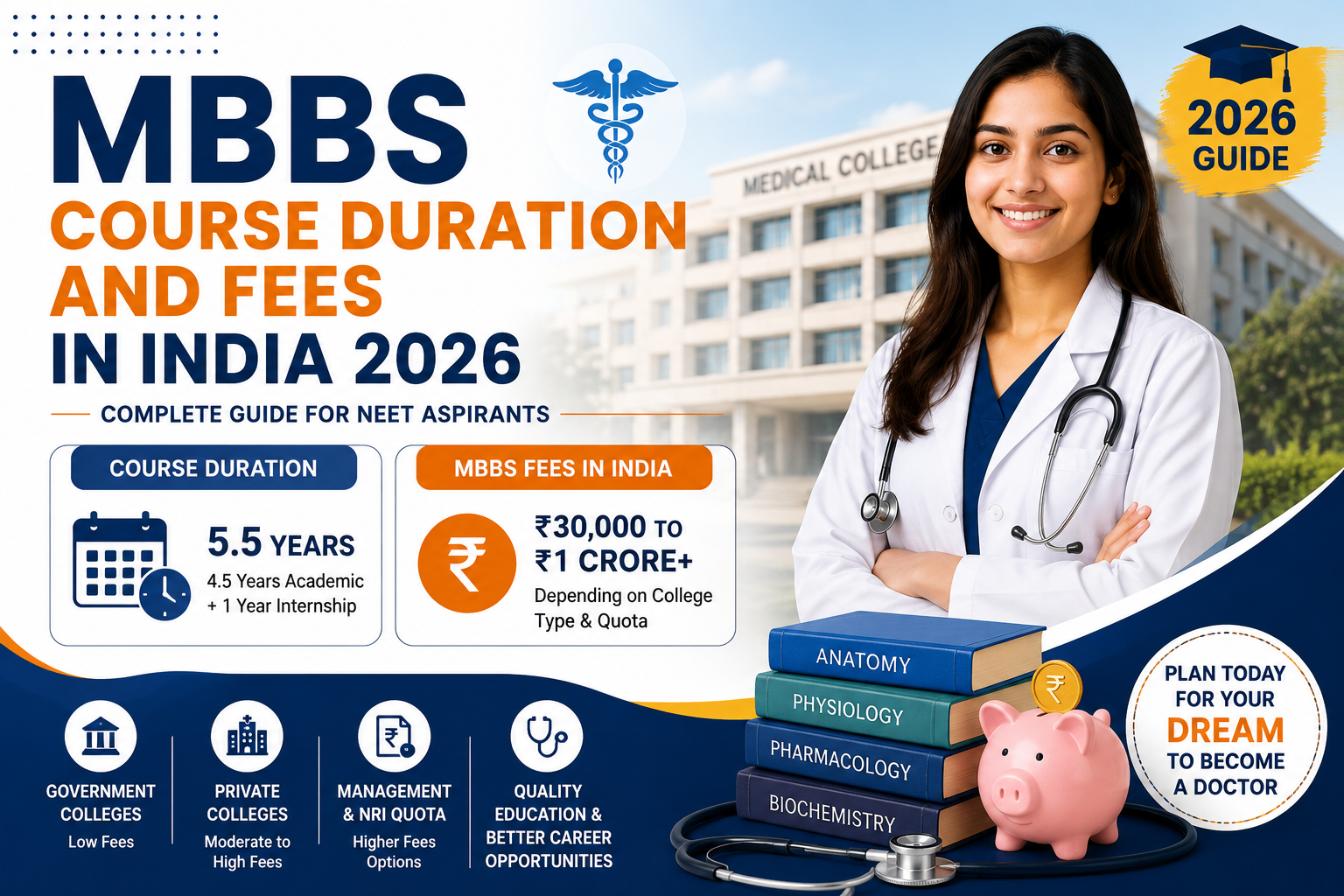
MBBS (Bachelor of Medicine and Bachelor of Surgery) is one of the most sought-after professional courses in India. Every year, lakhs of students appear for NEET-UG with the dream of becoming doctors and securing admission to top medical colleges. Before applying, students and parents often have two major questions: What is the duration of the MBBS course in India? and How much does MBBS cost in India?
Understanding the complete course structure, internship requirements, and fee variations among government, private, deemed, and NRI quota seats is essential for making informed decisions. This comprehensive guide covers everything about MBBS course duration and fees in India for 2026.
What is MBBS?
MBBS stands for Bachelor of Medicine and Bachelor of Surgery. It is the primary undergraduate medical degree awarded by medical colleges in India and is regulated by the National Medical Commission (NMC). After completing MBBS and the mandatory internship, graduates become eligible to register as medical practitioners and pursue postgraduate medical education.
MBBS Course Duration in India
The MBBS course duration in India is 5.5 years, consisting of:
- 4.5 years of academic education
- 1 year of compulsory rotating medical internship (CRMI)
This structure is followed by all NMC-recognized medical colleges in India.
MBBS Duration After 12th
Students often ask, “How many years does MBBS take after Class 12?”
The answer is:
| Component | Duration |
|---|---|
| Academic Study | 4.5 Years |
| Internship | 1 Year |
| Total Duration | 5.5 Years |
A student who joins MBBS immediately after Class 12 and clears all examinations on time typically completes the course within five and a half years.
Year-Wise MBBS Course Structure
First Professional MBBS
Duration: 1 Year
Subjects include:
- Anatomy
- Physiology
- Biochemistry
Students learn the basic structure and functioning of the human body while developing foundational medical knowledge.
Second Professional MBBS
Duration: 1.5 Years
Subjects include:
- Pathology
- Pharmacology
- Microbiology
- Forensic Medicine
- Community Medicine
This phase focuses on understanding diseases, medicines, microorganisms, and public health concepts.
Third Professional MBBS
Duration: 2 Years
Major clinical subjects include:
- General Medicine
- General Surgery
- Obstetrics and Gynecology
- Pediatrics
- Orthopedics
- ENT
- Ophthalmology
- Dermatology
- Psychiatry
Students gain practical exposure through hospital postings and patient interactions.
Internship During MBBS
After completing academic studies, students must complete a one-year compulsory rotating internship.
During the internship, students work in various departments such as:
- Medicine
- Surgery
- Pediatrics
- Obstetrics & Gynecology
- Community Medicine
- Emergency Medicine
The internship provides real-world clinical experience and is mandatory for obtaining registration as a doctor.
Eligibility for MBBS Admission in India
Students seeking MBBS admission must fulfill the following criteria:
Educational Qualification
- Pass Class 12 from a recognized board
- Physics, Chemistry, Biology, and English compulsory
NEET Qualification
- Must qualify NEET-UG
Age Requirement
- Minimum 17 years of age
NEET remains the only entrance examination for MBBS admissions in India.
MBBS Fees in India
MBBS fees vary significantly depending on:
- Type of medical college
- State regulations
- Quota category
- Institutional policies
The cost of MBBS can range from a few thousand rupees in government colleges to more than ₹1 crore in premium private institutions.
MBBS Fees in Government Medical Colleges
Government medical colleges offer the most affordable MBBS education.
Approximate Fee Range
| Category | Annual Fees |
|---|---|
| State Government Colleges | ₹5,000 – ₹1,00,000 |
| Central Government Colleges | ₹250 – ₹25,000 |
| AIIMS Institutions | ₹250 – ₹10,000 |
The total tuition fee for the complete MBBS course in many government colleges ranges from ₹30,000 to ₹6 lakh, excluding hostel and personal expenses.
MBBS Fees in AIIMS
AIIMS institutions are among the most affordable and prestigious medical colleges in India.
Estimated Fees
- Very low tuition fees
- Total course fee often remains under ₹25,000
- Additional charges may apply for hostel and other facilities
This makes AIIMS one of the most economical options for medical education.
MBBS Fees in Private Medical Colleges
Private medical colleges generally charge significantly higher fees.
Approximate Annual Fees
| Category | Annual Fees |
|---|---|
| Private Medical Colleges | ₹3 Lakh – ₹15 Lakh |
| Premium Private Colleges | ₹15 Lakh – ₹25 Lakh |
The total course cost can range between ₹20 lakh and ₹1 crore depending on the college and state.
MBBS Fees in Deemed Universities
Deemed universities often have the highest fee structures.
Approximate Fees
| Category | Annual Fees |
|---|---|
| Deemed Universities | ₹15 Lakh – ₹25 Lakh+ |
The total MBBS expenditure can reach ₹75 lakh to ₹1.25 crore or more over the entire course duration.
MBBS Fees Through Management Quota
Management quota fees vary widely across states and institutions.
Approximate Fee Range
| Category | Annual Fees |
|---|---|
| Management Quota Seats | ₹10 Lakh – ₹30 Lakh+ |
Students should carefully review the official fee structure before participating in counseling.
MBBS Fees Through NRI Quota
NRI quota seats are usually charged in foreign currency.
Approximate Fees
| Category | Annual Fees |
|---|---|
| NRI Quota | USD 20,000 – USD 100,000 |
The total cost may exceed ₹80 lakh to ₹3 crore depending on the institution and state.
Additional Expenses During MBBS
Apart from tuition fees, students should also consider:
Hostel Fees
₹50,000 – ₹2,50,000 per year
Mess Charges
₹30,000 – ₹1,00,000 per year
Books and Study Material
₹10,000 – ₹50,000 annually
Miscellaneous Expenses
- Examination fees
- Laboratory charges
- Uniforms
- Clinical equipment
These costs vary between institutions.
Important NMC Update on MBBS Fees
The National Medical Commission has clarified that medical colleges should charge tuition fees only for the 4.5-year academic period and not for the one-year compulsory internship. This measure aims to improve transparency and reduce unnecessary financial burden on students.
Government vs Private MBBS Fees Comparison
| Parameter | Government College | Private College |
|---|---|---|
| Annual Fees | ₹5,000 – ₹1 Lakh | ₹3 Lakh – ₹25 Lakh |
| Total Course Cost | ₹30,000 – ₹6 Lakh | ₹20 Lakh – ₹1.25 Crore |
| Competition | Very High | Moderate |
| NEET Score Requirement | Higher | Relatively Lower |
| Affordability | Excellent | Expensive |
Career Opportunities After MBBS
After completing MBBS, students can pursue:
- MD/MS
- DNB Programs
- Government Medical Services
- Clinical Practice
- Hospital Administration
- Medical Research
- Public Health
- USMLE
- PLAB
- International Medical Licensing Examinations
The demand for qualified doctors continues to grow across India and globally.
FAQS
Conclusion
The MBBS course duration in India is 5.5 years, including 4.5 years of academic study and one year of compulsory internship. The fee structure varies significantly depending on the type of institution, ranging from a few thousand rupees in government colleges to more than ₹1 crore in premium private and deemed universities. Students should carefully evaluate their NEET score, budget, preferred college, and future career goals before making admission decisions. With proper planning and counseling, aspiring doctors can find the best MBBS pathway that aligns with their academic aspirations and financial capabilities.